
Сондай-ақ қараңыз


 16.09.2026 08:37 AM
Yesterday was fairly calm despite a lot of mixed fundamental data.
For the euro, the key factor was the latest German ZEW readings — a monthly survey of financial analysts about Germany's economic prospects. The expectations index barely moved, while the assessment of current conditions improved noticeably; conversely, euro-area expectations declined against the backdrop of last week's European Central Bank rate hike. This divergence between a more resilient German economy and weakening euro-area expectations continues to weigh on EUR/USD, especially as the market digests the ECB's hawkish stance after last week's decision.
The pound received a mixed labor-market signal: a sharp jump in jobless-claim filings triggered an initial wave of selling, but the unchanged unemployment rate at 4.9% prevented a larger GBP/USD sell-off. I believe the combination of moderately positive UK data, a hawkish ECB and mixed British releases keeps the backdrop tilted toward the dollar, and I do not expect any significant recovery today for either the euro or the pound.
In the US, the Empire State manufacturing index fell by 13 points in September to 7.6, pulling back from August's four-year high — but note this is a snapshot of New York state manufacturers' current conditions and the drop does not yet imply a trend reversal, since the reading remains positive. New orders edged up slightly while shipments eased a bit; note the divergence between demand and production. Also important: delivery times lengthened, and raw-material shortages intensified — components that traditionally signal rising pressure on supply chains and are consistent with accelerated growth in input and output prices from already high levels. Employment and workweeks rose, and firms remain fairly optimistic about the near term despite the index softening.
The main event of the day remains the Federal Reserve's rate decision. The central bank held policy at 3.50–3.75% over five meetings, but markets now price roughly a 90% chance of a hike to 4.0%, and that confidence itself is supporting the dollar in advance. Also today, the UK will publish August inflation — expected to accelerate to 3.1% year-on-year from 2.9% — and this number matters because it will directly influence the Bank of England's stance tomorrow: the bigger the upside surprise, the harder it will be for the BoE to keep rates unchanged. Still, the day's primary focus is not the Fed rate figure itself but Fed Chair Kevin Warsh's rhetoric at the evening press conference — his tone will determine whether the dollar keeps strengthening after the decision or hands back gains to the euro and the pound on more cautious forward guidance.
For the euro, the key upside pivot is 1.1551; a break above it could push the pair to 1.1571 and then 1.1595. That scenario, however, requires a rapid shift in market sentiment within hours ahead of the Fed decision, which is rare. Far more workable, in my view, is a break below 1.1529, opening the road to 1.1507 and 1.1486 — the path that aligns with today's backdrop, from weak euro-area expectations to strong market conviction about a US rate hike.
For the pound, the upside pivot is 1.3494, which could take price to 1.3512 and then 1.3531. For sterling to reach those levels, it would need either a surprise strong inflation print today or an obvious failure of the dollar rally. A break below 1.3464 toward 1.3435 and 1.3401 looks much more logical, especially given that the pound already had a reason to weaken this morning after the jump in jobless-claim filings.
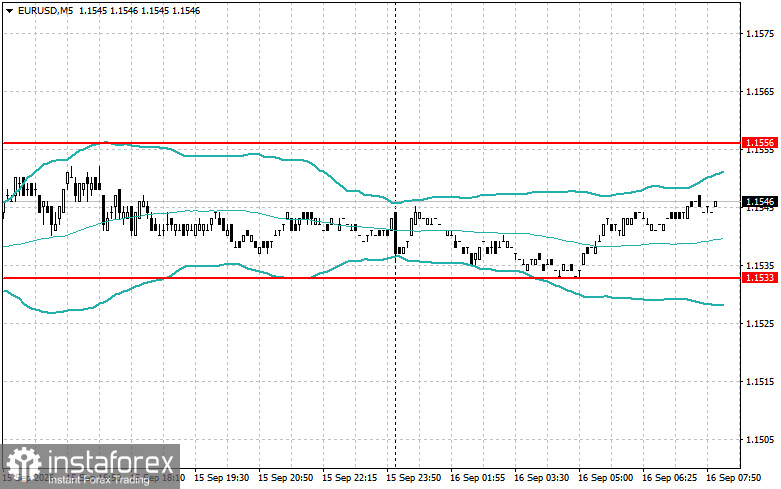
For the euro, I'm watching the upper boundary at 1.1556. The idea is simple: the pair tries to hold above, but buyers for continuation don't appear, and price slides back down—that becomes the trigger to sell. Ahead of the Fed decision, this scenario looks quite appropriate, since market participants are unlikely to take large positions against the dollar just hours before the rate announcement. The lower reference 1.1533 works by the opposite logic — I look for long positions after a failed break below that boundary — but exercise special caution here: buying against the dollar on the eve of a meeting where the market is almost certain of a hike is not easy, and the target for such a rebound should be set very modestly.
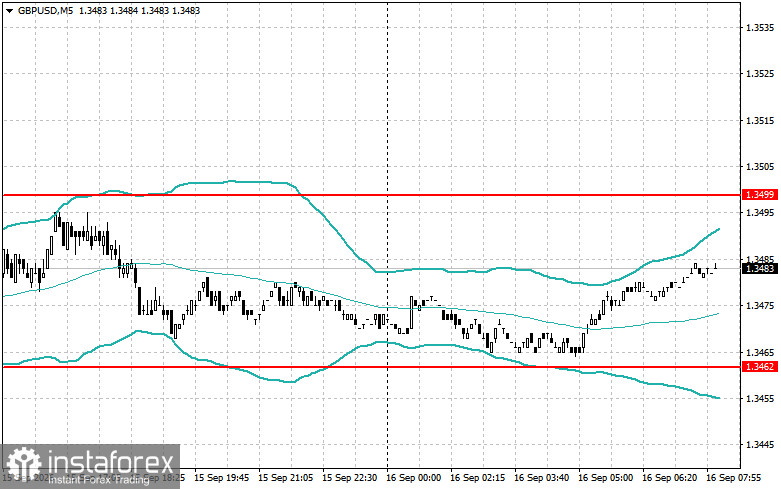
For the pound, the upper boundary is 1.3499. The same return logic applies here: a move above without follow-through is a sell signal, and given the pound's general weakness after this morning's labor-market figures, that outcome looks quite plausible. The lower reference 1.3462 implies buying on a rebound after a false downside break, but trade this scenario with caution: the backdrop for sterling is so unfavorable right now that even a successful technical bounce is likely to be short-lived before the pair resumes selling.

