
Veja também


 14.09.2026 09:35 AM
Today Brent already rose above $108 per barrel and then corrected. WTI gained the same 2.6 percent to $102.68. The cause was Saudi Arabia's closure of the East-West pipeline, which the kingdom announced late on Friday as a precautionary measure after recent attacks. No timeline for resumption was given.

Experts note that the significance of this facility is hard to overstate, and it's not just about its capacity of roughly 7 million barrels per day. This route served as the key way to bypass the Strait of Hormuz throughout the US–Iran war. Oil moved from the kingdom's east coast across the country to Yanbu on the Red Sea, avoiding the blocked strait. Now the bypass is closed, and the strait itself remains under threat.
Sparta Commodities noted that everything now depends on duration, explaining that a rapid resumption would limit the effect since Yanbu inventories could be tapped, but a protracted shutdown could force production cuts. DBS Bank's Suvro believes Yanbu's storage can support exports for five to seven days, beyond which massive disruptions will follow.
For now, until the repair situation is clarified, the near-term price trajectory points to a possible test of $120 per barrel.
The most explosive detail concerns the attack's origin. Iraqi Prime Minister Ali Al-Zaidi on Saturday ordered an investigation and said the strikes came from a territory in a region bordering Iran. I am convinced this fundamentally changes the conflict's geography, because until now strikes came by sea and from Yemen, and now a third country formally not at war is drawn into the chain.
Meanwhile, diplomatic efforts have completely stalled, and the strait is directly linked to the pipeline. A planned Monday meeting between Iran and several Gulf states to create a temporary shipping corridor through Hormuz was postponed, Oman's foreign minister Badr Al-Busaidi said.
A vicious circle forms that the parties cannot yet break. An attack on the bypass undermines trust in talks about the strait itself, the collapse of talks cements the blockade, and the blockade increases the value of bypass routes, which then become targets.
Market indicators confirm the severity of physical shortage. The spread between the two nearest Brent contracts widened to $5.57 per barrel in backwardation versus $3.84 a week earlier. Such a curve structure, where the prompt contract trades at a premium to the next, directly signals a shortage of immediate deliveries. I will add that Saudi production last month had already fallen to a 1990-era low even before the pipeline attack.
I expect Brent to test $115–120 within the next two weeks if the pipeline is not back in operation by week's end, since the five-day stock in Yanbu creates a hard deadline. If repairs take longer than the market expects, prices could go even higher. For the Federal Reserve, meeting on Wednesday, the oil factor will outweigh any nuances in inflation data, because a rise of more than three quarters since the start of the year cannot be dismissed as temporary.
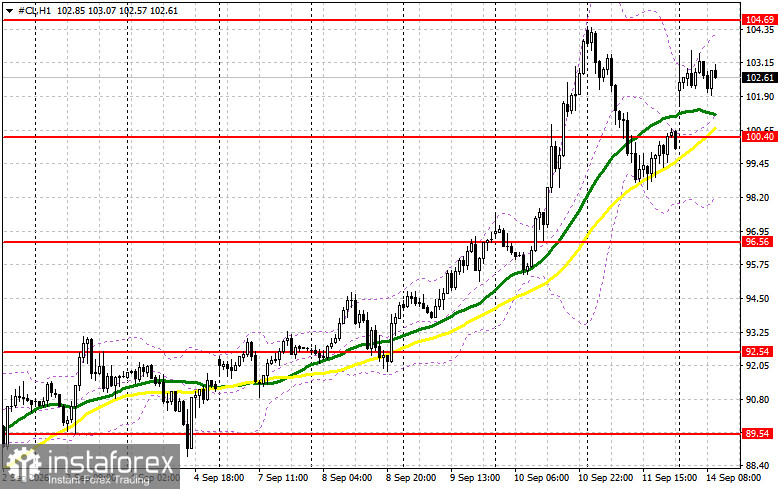
As for the current technical picture for oil, buyers need to take the nearest resistance at $104.70. This sets up a target of $109.30, above which a breakout will be difficult. The farthest target is the $113.40 area. If it drops, bears will try to seize control of $100. If they succeed, a range breakout will deliver a serious blow to bulls' positions and push Oil toward the $96.54 low, with a prospect of extending to $92.


