
Vea también


 17.09.2026 05:50 AM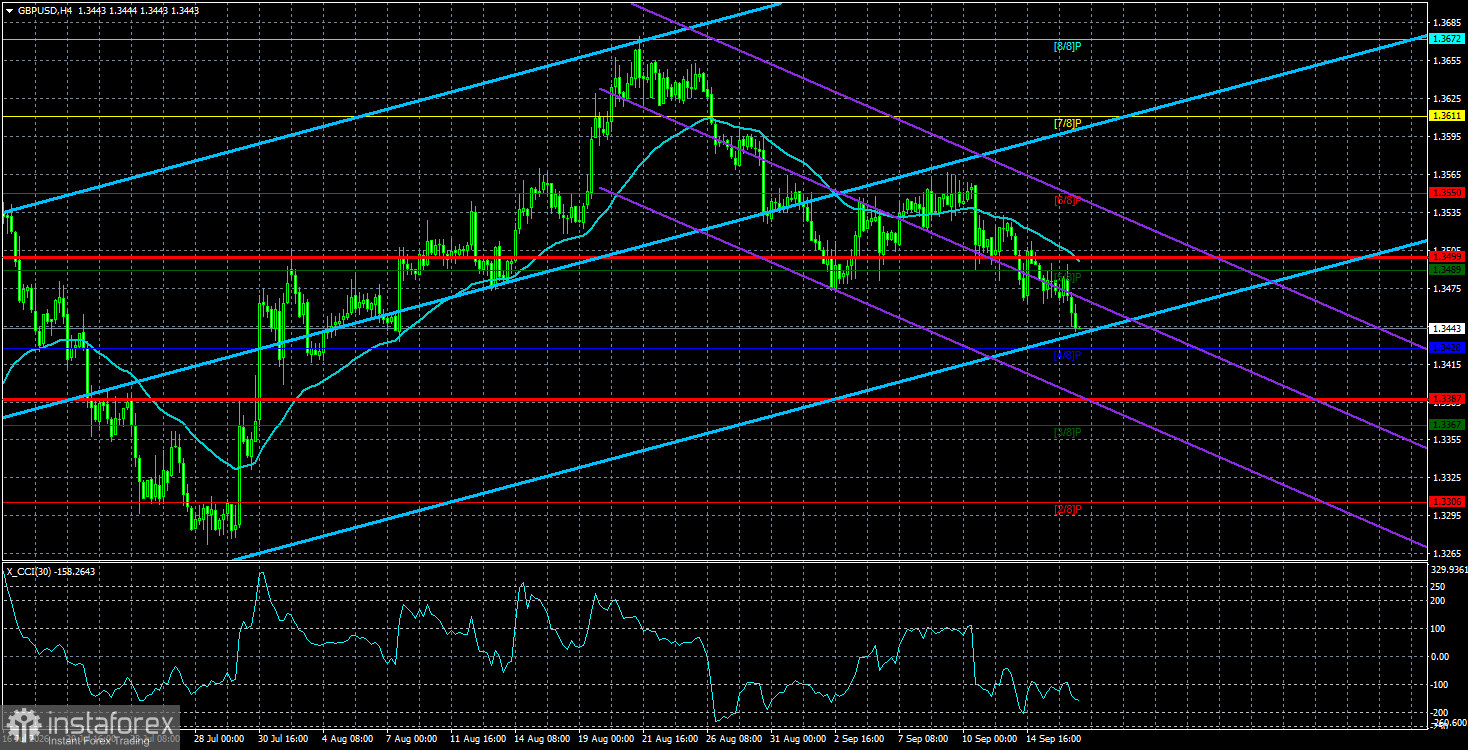
The GBP/USD currency pair traded fairly calmly on Wednesday, and the UK inflation report had no measurable impact on the pound's movement. Today the Bank of England meets, and we will learn the rate decision and the Monetary Policy Committee vote results. The BoE appears unlikely to tighten policy in September, yet its medium-term stance remains considerably more hawkish than, for example, the Federal Reserve's.
UK inflation in August did not answer whether the key rate must rise this month. Headline CPI accelerated to 3.1% as expected, while core inflation remained unchanged at 2.6%. In other words, inflation picked up but not strongly enough to trigger alarm. Therefore, the BoE will most likely adopt a wait-and-see stance today, and its announcement is expected to be neutral, provoking only a short-lived spike in volatility.
The most interesting event today is the Monetary Policy Committee vote on the policy rate. Three MPC members are expected to take a hawkish position, while six remain neutral. Such a split would produce little market reaction. If the number of hawks exceeds three, the pound would receive modest support — but not more than four hawks, because a majority of nine voting members would be required to lift the rate.
We also note the BoE meeting may be in the Fed's shadow. As mentioned earlier, markets can take up to 24 hours to fully process the Fed's outcomes, so today's moves may be driven less by the BoE and more by ongoing adjustments to the Fed decision. And of course Fed decisions generally carry greater weight for markets than BoE moves.
In our view, the BoE has the capacity to raise the key rate at least three times in 2026–2027, depending on inflation dynamics — three hikes are our base case. Whether the Fed raises more than once is much less certain. We continue to think a single Fed hike may be aimed more at restoring confidence in Kevin Warsh than at decisively fighting inflation. Thus, over the longer term the BoE appears the more consistently hawkish central bank. Combined with the technical picture on higher timeframes, this supports our long-standing view for 2026: sterling should appreciate, because the dollar lacks structural reasons for a strong and sustained rally.
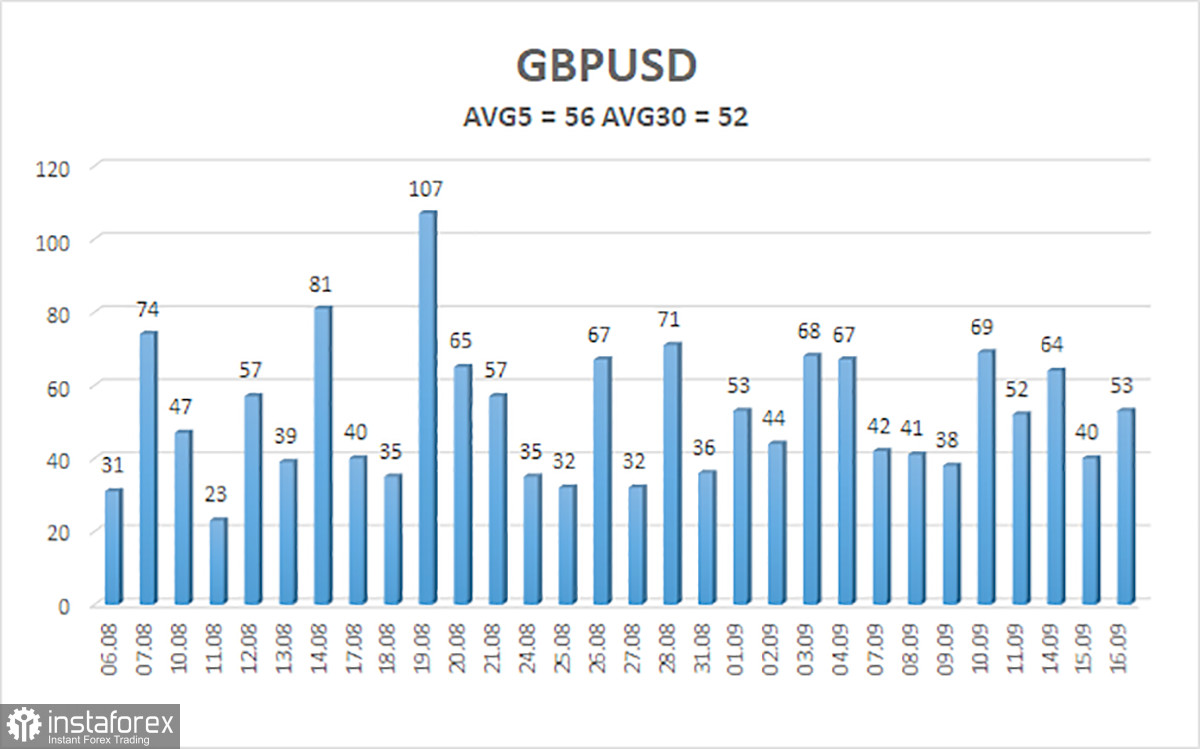
The average volatility of the GBP/USD pair over the last 5 trading days is 56 pips. For the pound/dollar, this value is classified as "low." Therefore, on Thursday, September 17, we expect movement inside a range bounded by 1.3387 and 1.3499. The higher linear-regression channel has turned up, indicating an uptrend. The CCI entered the oversold area, warning of a possible end to the correction.
S1 – 1.3428
S2 – 1.3367
S3 – 1.3306
R1 – 1.3489
R2 – 1.3550
R3 – 1.3611
The GBP/USD pair maintains an uptrend. Donald Trump's policies will continue to weigh on the US economy, so we do not expect long-term dollar strength. So far, 2026 has been positive for the dollar due to geopolitics, but every story comes to an end. On the weekly timeframe, a flat range remains between 1.3150 and 1.3780 within a four-year uptrend, supporting expectations for continued pound appreciation in the medium term. Long positions with targets 1.3550 and 1.3611 can be considered while price is above the moving average. Price below the moving average would justify bearish trading, with targets of 1.3387 and 1.3367.
Regression channels help determine the current trend. If both are directed in the same direction, it means the trend is currently strong;
The moving average line (settings 20,0, smoothed) defines the short-term trend and the direction in which trading should be conducted at present;
Murray levels are target levels for moves and corrections;
Volatility levels (red lines) are the probable price channel within which the pair will spend the next 24 hours based on current volatility indicators;
The CCI indicator – its entry into the oversold area (below -250) or the overbought area (above +250) indicates that a trend reversal in the opposite direction is approaching.


