
Shuningdek qarang


 15.09.2026 04:45 AM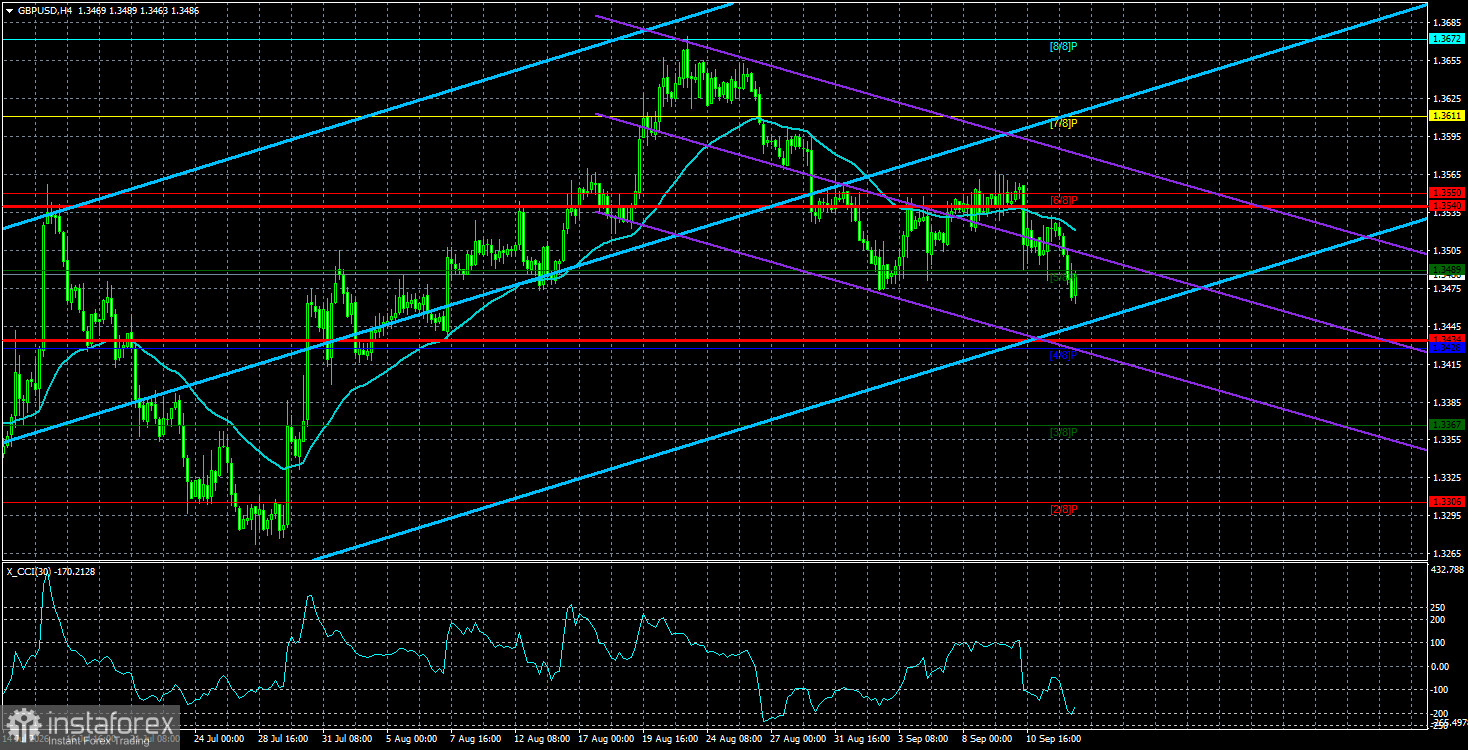
The GBP/USD currency pair also fell on Monday, but much less than EUR/USD. This raises the question: why is the euro falling while the pound is not, when the European Central Bank has already delivered a second round of monetary tightening this year, whereas the Bank of England has not — and the UK seems to be on the edge of disintegration? As always, there is no single clear answer. Unfortunately, when prices move in the FX market, no explanatory notes tell us why particular players decided to buy or sell a currency. Traders, analysts, and other market participants are left to build theories, each more elaborate than the next.
We should say up front that we do not like concocting conspiracy theories. Market moves often defy simple logic and common sense. To be precise, you can always come up with an explanation after the fact — but who needs post-hoc rationalizations? The main task for any trader or analyst is to forecast the move. Anyone can invent a neat story after the move, but such explanations have limited practical value.
Today the pound is under pressure, and the market is focused on the Federal Reserve and BoE meetings. The market is so concentrated on those events that even headlines about a possible break-up of the United Kingdom barely register. That is why we do not see reasons to dwell on topics such as a treaty that would allow Northern Ireland, Wales and Scotland to hold independence referendums, or on geopolitics, which is worsening by the day.
By Wednesday evening the market will be about 90% clear on the direction to trade. If the Fed tightens and that decision marks the start of a sustained hiking cycle, the dollar could enter a new prolonged uptrend. If the Fed does not tighten, disappointment is likely to sweep the market — traders have spent the summer anticipating U.S. rate hikes. The BoE's meeting will only tweak overall sentiment. Because the BoE is not under the same political shadow as the Fed is from the U.S. administration, it is free to act as it sees fit. That means a BoE rate increase at this meeting or the next is possible. If that happens, sterling would be relatively better positioned than the dollar, and the dollar would need more than a single Fed hike to sustain a new trend — the Fed must signal readiness to raise the key rate several times. "Several times" matters because a single 25 bp increase is unlikely to be enough to bring inflation down to 2%, and so would be largely ineffective. What would happen to U.S. employment and the economy if the Fed embarks on a full tightening cycle is hard to predict.
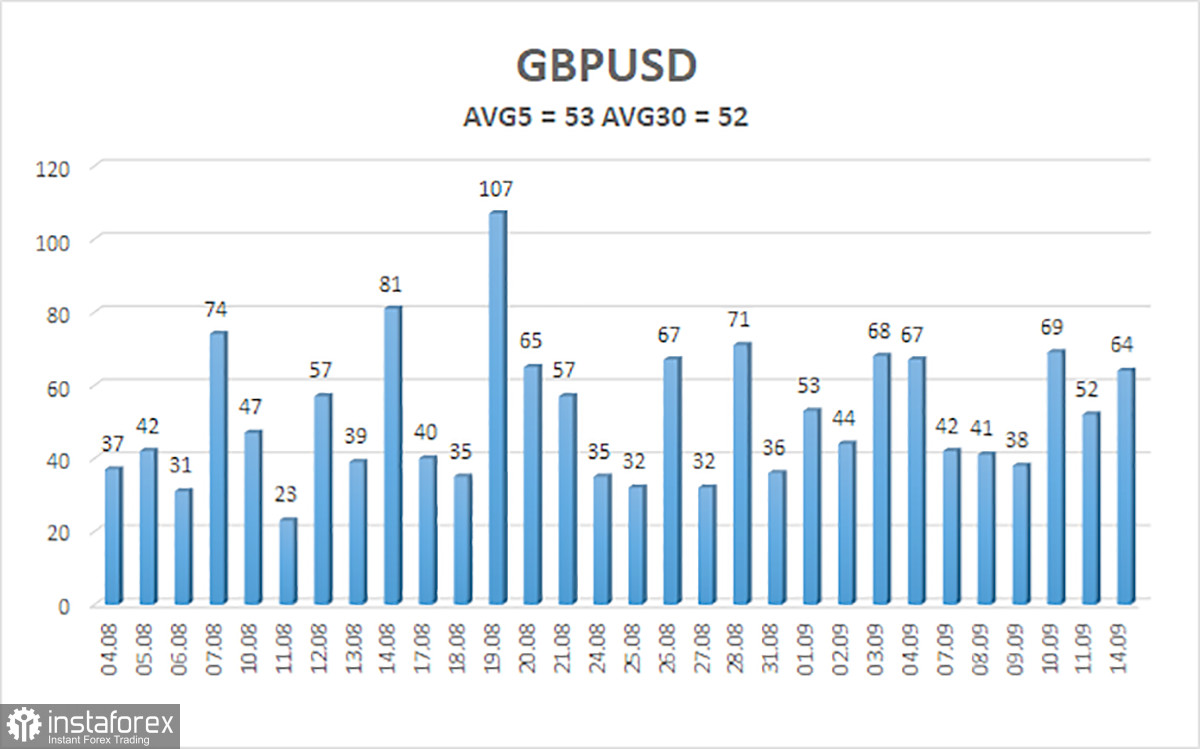
The average volatility of the GBP/USD pair over the last 5 trading days is 53 pips. For the pound/dollar pair, this value is classified as "low." Therefore, on Tuesday, September 15, we expect movement inside a range bounded by 1.3434 and 1.3540. The higher linear-regression channel has turned up, indicating an uptrend. The CCI entered the oversold area, warning of a possible end to the correction.
S1 – 1.3428
S2 – 1.3367
S3 – 1.3306
R1 – 1.3489
R2 – 1.3550
R3 – 1.3611
The GBP/USD pair maintains an uptrend. Donald Trump's policies will continue to weigh on the US economy, so we do not expect long-term strength from the US dollar. So far, 2026 has been positive for the dollar due to geopolitics, but every story comes to an end. On the weekly timeframe, a flat remains between 1.3150 and 1.3780 within a four-year uptrend, supporting expectations for continued pound appreciation in the medium term. Long positions with targets 1.3611 and 1.3672 can be considered while price is above the moving average. Price below the moving average would allow bearish trading, with targets at 1.3434 and 1.3428.
Regression channels help determine the current trend. If both are directed in the same direction, it means the trend is currently strong;
The moving average line (settings 20,0, smoothed) defines the short-term trend and the direction in which trading should be conducted at present;
Murray levels are target levels for moves and corrections;
Volatility levels (red lines) are the probable price channel within which the pair will spend the next 24 hours based on current volatility indicators;
The CCI indicator – its entry into the oversold area (below -250) or the overbought area (above +250) indicates that a trend reversal in the opposite direction is approaching.

