
Xem thêm


 17.09.2026 05:42 PM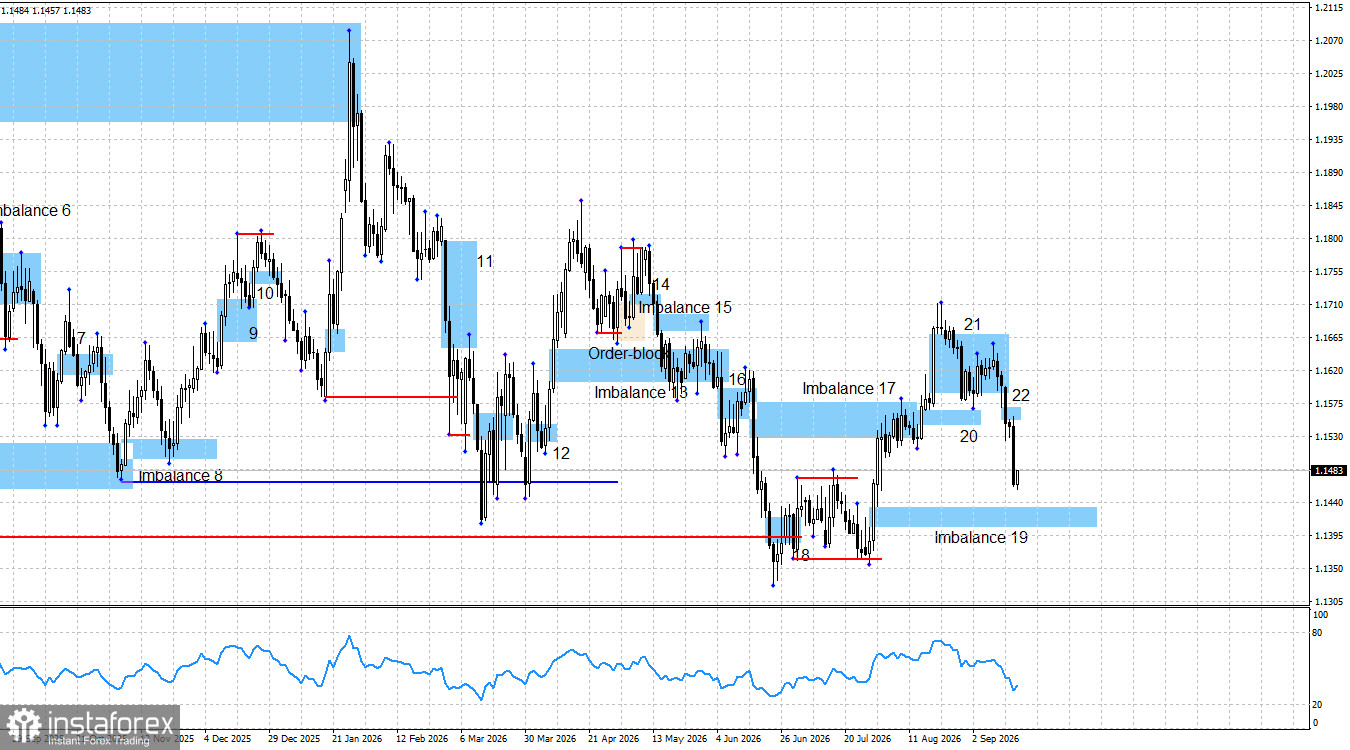
The EUR/USD pair is ending the current week with overall losses of 200 points. The decline in the European currency began last week as the market prepared for an FOMC key interest rate hike on Wednesday. As it turned out, a 100-point strengthening of the dollar was insufficient to reflect the FOMC's monetary policy tightening. The dollar rose by another 100 points. Thus, the bulls spent almost an entire week attacking based on the single factor of a Fed rate hike. As part of this move, the European currency fell almost to imbalance 19, which can currently be considered the last hope and support. If this imbalance is invalidated, the European currency will not simply continue to decline but has every chance of falling below the psychological level of $1.10. Who expected such a development at the beginning of the year? Yesterday, the FOMC Committee signaled its readiness to continue tightening policy, which proved sufficient for the bears to launch new attacks. If Kevin Warsh reports again tomorrow that inflation in the United States is too high, will the market rush to buy the dollar again? In my view, we are going around in circles. In any case, even after monetary policy tightening in September and possible further tightening in November or December, I do not see what other reasons could force traders to continue buying the U.S. currency. The dollar has indeed performed exceptionally well in recent weeks, but what factors have supported it during this period? FOMC monetary policy tightening and nothing else?
Overall, in my view, the information backdrop continues to favor the bulls. First, it is clearly visible on any chart that the European currency began its rise from relatively low levels over the past year compared with the average price over the same period. This means that it still has upward potential. Second, the market continues to doubt that the FOMC will maintain monetary policy tightening over an extended period. Third, U.S. economic data have recently been disappointing for the most part. Fourth, geopolitics no longer supports the bears or the dollar. Fifth, the ECB has already implemented two rounds of monetary policy tightening in 2026. Sixth, the U.S. Treasury has decided to increase its purchases of long-term bonds, which reduces demand for the dollar. Seventh, a trade war has begun between the United States and Canada. Eighth, the U.S. labor market in 2026 is doing only slightly better than in 2025. Thus, I currently see no reason for a bearish advance.
The current chart picture indicates a break in the bullish momentum. Only bullish imbalance 19 can save the bulls. If a reaction to it occurs or a reversal in favor of the euro takes place above this pattern, the bulls may attempt to start a new trend. I repeat: apart from FOMC policy tightening, I see no reason for the dollar to rise. I would also remind you that the FOMC is not the only central bank tightening policy in 2026.
The economic backdrop on Thursday had no effect on traders' sentiment. The morning inflation report from the European Union confirmed a slowdown to 2.4%, while data on building permits and housing starts in the United States only strengthened the market's desire to make a slight correction in EUR/USD.
There are still a huge number of reasons for the bulls to attack in 2026. Structurally and globally, Trump's policies, which led to a significant decline in the dollar last year, have not changed. At present, I see no significant factors supporting the U.S. currency despite the FOMC's hawkish stance. Geopolitics, which supported demand for the U.S. currency for most of the first half of 2026, no longer does so.
News calendar for the United States and the European Union:
On September 18, the economic events calendar contains two entries, neither of which attracts attention. The impact of the economic backdrop on market sentiment on Friday may be extremely weak or absent.
EUR/USD Forecast and Trading Tips:
In my view, the pair remains in the process of forming a bullish trend that has taken a one-year pause. The information backdrop shifted sharply in favor of the bears six months ago, but the trend itself cannot be considered canceled or complete. In the long term, I would say that the pair is trading within a range. However, the range does not invalidate the broader bullish trend. Thus, the bulls may resume their advance in 2026, but their only remaining opportunity is imbalance 19. In addition, a sell signal was formed in imbalance 22 yesterday, so there is currently no talk of bullish attacks. The target for the decline in the European currency remains the 1.1406–1.1434 level.

